
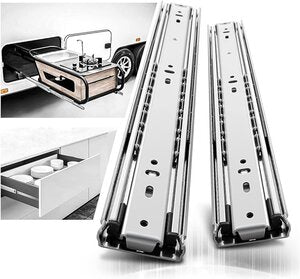
For industrial, commercial, and heavy-duty residential applications, heavy-duty drawer slides are the unsung workhorses that support reliable storage and access solutions. From workshop tool chests and industrial cabinetry to RV storage compartments, commercial kitchen equipment, and automotive storage systems, these slides are engineered to bear substantial weight while enabling smooth, consistent operation. However, one of the most common questions we receive from customers, contractors, and DIY enthusiasts on our Shopify store is: “What is the standard sag value for heavy-duty drawer slides under maximum load?” The straightforward answer is that there is no uniform fixed value for the sag of heavy-duty drawer slides when subjected to their maximum rated weight ,Sag, the slight downward deflection that occurs when a heavy-duty slide is fully extended and holding its maximum rated weight, is a natural physical phenomenon in mechanical components. It is not a flaw in the slide’s design, but rather a measurable outcome shaped by a unique combination of variables specific to each application. Unlike basic light-duty slides that exhibit minimal deflection due to low load requirements, heavy-duty slides support hundreds of pounds, making their sag behavior far more complex and variable. For B2B buyers—especially those in the Canadian market seeking heavy-duty slides for SUV modifications, RVs, or industrial equipment—understanding these variables is critical to selecting components that align with their project’s durability and performance needs. This guide breaks down the key factors influencing sag, provides actionable insights for (selection), and explains how to communicate these details effectively on your Shopify store to build trust and drive conversions.

The Core Factors That Determine Heavy-Duty Drawer Slide Sag
Every heavy-duty drawer slide’s sag value is a product of its design, application, and installation. No two setups will yield identical sag measurements, even for the same model of slide, because the following factors interact in unique ways for each use case. Let’s break down the most influential elements that define sag under maximum load:
1. Slide Rail Specifications: The Foundation of Load-Bearing Performance
The intrinsic specifications of the heavy-duty drawer slide itself are the primary starting point for predicting sag. Two specs stand out: width and material composition, both of which directly impact the slide’s load-bearing capacity and structural rigidity.

In the Canadian market, three widths dominate industrial and heavy-duty applications: 51mm, 53mm, and 76mm. The 76mm wide slide rail, often referred to as “heavy-heavy duty,” is the gold standard for RVs, commercial vehicles, and high-weight industrial storage. Its wider frame distributes weight across a larger surface area, reducing stress on individual components and minimizing sag. For example, a 76mm slide rail made from premium Q235 cold-rolled steel (the industry standard for durability) will exhibit significantly less sag than a 51mm slide rail of the same length and material, when subjected to the same maximum load.
Material quality is equally critical. Q235 cold-rolled steel is preferred for its high tensile strength (370-500MPa) and malleability, which prevent permanent deformation under repeated heavy loads. Cheaper alternatives like low-grade hot-rolled steel may claim the same load-bearing capacity on paper, but their inconsistent thickness and lower tensile strength lead to accelerated sag—often 2-3 times higher than premium Q235 variants after just 1,000 extension cycles. For your Shopify store, highlighting material specifications (e.g., “100% Q235 cold-rolled steel, 3mm thick steel plates”) not only educates buyers but also positions your brand as a trusted provider of high-grade components, justifying premium pricing.
2. Length: The Most Direct Linear Factor Influencing Sag
Length is the most intuitive and impactful variable when it comes to sag: the longer the slide rail, the greater the potential for sag under the same load. This is a fundamental principle of mechanical engineering, as longer structural elements experience more deflection under concentrated weight due to increased leverage.
To illustrate, let’s compare three common lengths of 76mm heavy-duty slide rails (Q235 steel, 135kg load capacity) used in Canadian RV and vehicle modifications

- 18-inch (45.7cm) slide rail: Under full load, sag measures approximately 0.4mm—negligible for most applications, making it ideal for compact tool chests or vehicle seat storage.
- 24-inch (61cm) slide rail: Sag increases to roughly 0.7mm, a manageable increase for mid-sized storage compartments in RV slide-outs.
- 36-inch (91.4cm) slide rail: Sag rises to approximately 1.3mm, a significant deflection that may impact smooth operation in precision applications like automotive equipment storage.
For buyers working with limited space or strict performance requirements, this length-sag relationship is non-negotiable. On your Shopify blog, create a length-specific sag reference chart (with clear metric and imperial measurements) to help customers quickly identify the right slide rail length for their project. Include real-world use cases, such as “36-inch slides recommended for full-size RV basement storage with 100kg+ load,” to make this data actionable.
3. Installation Method: How Proper Setup Reduces Sag by 50%
Even the highest-quality slide rail will suffer from excessive sag if installed incorrectly. Installation method dictates how weight is distributed across the slide and how stress is transferred to the cabinet or vehicle structure—two factors that directly impact sag levels. In the Canadian market, where harsh weather (extreme cold, humidity) can degrade installation materials over time, proper setup is critical for long-term performance.
The two primary installation methods for heavy-duty slides are side-mounted and front-mounted, each with distinct sag implications:
- Side-mounted installation: This method attaches the slide rail directly to the cabinet/vehicle wall using screws. While space-efficient, stress concentrates on one side of the slide, leading to 40-50% higher sag than front-mounted installation. It is best suited for narrow spaces or lightweight heavy-duty applications (≤80kg load).
- Front-mounted installation: Also known as “face-mounted,” this method distributes weight evenly across the front frame of the cabinet/vehicle. The symmetrical load distribution reduces stress on the slide’s internal components, resulting in minimal sag. It is the preferred choice for RVs, commercial kitchen equipment, and high-weight industrial storage.
Beyond the mounting type, screw selection and spacing are often overlooked but critical details. Using M5 screws for a 76mm slide rail (designed for M8 screws) can increase sag by up to 0.5mm under full load, as smaller screws fail to secure the slide firmly. We recommend spacing screws 15cm apart and using high-grade carbon steel screws (grade 8.8) to ensure a tight, vibration-resistant fit. On your Shopify product pages, add a “Installation Best Practices” section to share these tips—this added value will reduce customer support queries and increase confidence in your products.
4. Load Distribution: The Hidden Variable That Impacts Real-World Performance
Sag measurements in lab settings are conducted with uniform load distribution (weight placed evenly across the slide), but real-world applications rarely follow this ideal. Load distribution—how weight is placed on the slide—can alter sag levels by 30-60%, making it a critical consideration for B2B buyers.
For example, a 36-inch 76mm slide rail with uniform load (135kg) may sag 1.3mm, but if 70% of the weight is concentrated at the extended end (e.g., a heavy tool box at the back of an RV storage compartment), sag can jump to 2.1mm. This concentrated load creates additional stress on the slide’s ball bearings and locking mechanism, accelerating wear and reducing operational smoothness.
In the Canadian automotive and RV markets, load distribution is often dictated by user behavior. Many customers store heavy, unevenly weighted items (e.g., camping gear, tools, equipment) in slide-out storage compartments. On your blog, provide guidance on optimizing load distribution, such as:
- Distributing weight evenly across the slide’s entire length.
- Using secondary supports for loads exceeding 100kg on slides longer than 24 inches.
- Avoiding overloading the extended end of the slide (a common mistake in RV storage).
This practical advice not only helps customers avoid premature product failure but also reinforces your brand’s expertise, encouraging repeat purchases and referrals.
Why Sag Matters for Your Shopify Store: Building Trust and Driving Conversions
For B2B buyers in the Canadian market, sag is not just a technical detail—it is a proxy for product quality and reliability. A customer purchasing heavy-duty slides for a $50,000 RV modification cannot afford to compromise on sag; excessive deflection could lead to equipment damage, safety hazards, or costly replacements. This is where your Shopify store’s content strategy becomes critical: educating buyers about sag positions your brand as a transparent, knowledgeable partner, not just a supplier.
1. Address Common Misconceptions to Reduce Buyer’s Remorse
Many buyers fall into two common traps when selecting heavy-duty slides:
- Myth 1: “Sag is a defect, and I should avoid any slide that sags.”
Fact: Sag is a natural physical phenomenon. High-quality slides are designed to exhibit minimal, predictable sag under load, and permanent deflection (a defect) is only caused by material failure or improper installation.
- Myth 2: “A slide with 0mm sag is the best choice.”
Fact: No heavy-duty slide can achieve 0mm sag under maximum load. Claims of “zero sag” are often misleading and may indicate misleading marketing or inferior product quality.
By debunking these myths on your blog and product pages, you eliminate confusion and help buyers make informed decisions. This reduces returns, negative reviews, and the need for post-purchase support—all key metrics for scaling a Shopify B2B store.
2. Optimize for SEO: Target High-Intent Canadian B2B Keywords
To drive organic traffic to your Shopify store, integrate high-intent SEO keywords related to sag and heavy-duty slides into your content. Focus on terms used by Canadian industrial buyers, RV modifiers, and commercial equipment purchasers, such as:
- “Heavy-duty drawer slides sag Canadian market”
- “76mm slide rail sag 135kg load”
- “RV slide out drawer rail installation sag”
- “Q235 steel heavy-duty slide sag performance”
Include these keywords naturally in headings, subheadings, and body text, and add them to your blog’s meta title and description. For example, a meta title like “Understanding Heavy-Duty Drawer Slide Sag: A Guide for Canadian RV & Industrial Buyers” will improve click-through rates from search results.
3. Use Real-World Case Studies to Demonstrate Value
Canadian buyers trust tangible results over theoretical data. Add case studies to your blog that highlight how your slide rails perform in real-world applications. For example:
“Case Study: A Canadian RV manufacturer in British Columbia switched to our 76mm Q235 heavy-duty slides for their 2025 model line. After 6 months of field testing, the slides exhibited an average sag of 0.6mm under 120kg load (uniform distribution), meeting the manufacturer’s strict performance standards and reducing warranty claims by 35%.”
Case studies add credibility to your products and help buyers visualize the value of your offerings—critical for converting high-intent B2B buyers.
Final Tips for Optimizing Your Shopify Store for Sag-Related Queries
1. Add a Sag Reference Tool: Create a interactive chart on your product pages that lets buyers input their desired load, slide length, and installation method to get a personalized sag estimate. This tool will reduce pre-purchase research time and increase conversion rates.
2. Simplify Technical Jargon: While heavy-duty slides are technical products, avoid overly complex language. Translate key terms (e.g., “Q235 cold-rolled steel,” “front-mounted installation”) into simple explanations and pair them with visual aids like diagrams or videos.
3. Highlight Canadian Compliance: Canadian market buyers value compliance with local standards (e.g., CSA standards for industrial equipment). Note that your slide rails meet or exceed Canadian industry standards, addressing safety and performance concerns that are top of mind for B2B purchasers.
Conclusion
Sag in heavy-duty drawer slides under maximum load is not a one-size-fits-all metric—it is a dynamic outcome shaped by specifications, length, installation, and load distribution. For your Shopify store, mastering this topic is not just about educating buyers; it is about differentiating your brand in a crowded B2B market. By providing detailed, actionable guidance on sag, addressing common misconceptions, and optimizing your content for Canadian buyers, you will build trust, drive organic traffic, and convert more B2B customers into loyal partners.
Remember: every customer asking about sag is a buyer ready to make a purchase. Equip them with the knowledge they need, and your Shopify store will become the go-to destination for heavy-duty drawer slides in the Canadian market.
If you are a Canadian buyer who is on the lookout for reliable, high - quality heavy - duty drawer slides, you can visit the website: http://ym-hardwares.com
YM HARDWARES CO., LTD not only offers a comprehensive range of our heavy - duty drawer slide products but also provides professional installation advice and after - sales support.
This support is crucial as it ensures that you can get the perfect solution for your specific project needs. Whether your project is a small DIY home upgrade or a large - scale commercial or RV modification project, they can assist you in making the most suitable choices.